
By Gerard Creaner (B.Chem Eng,)
Last updated: June 2026
Estimated Reading Time: 19 minutes
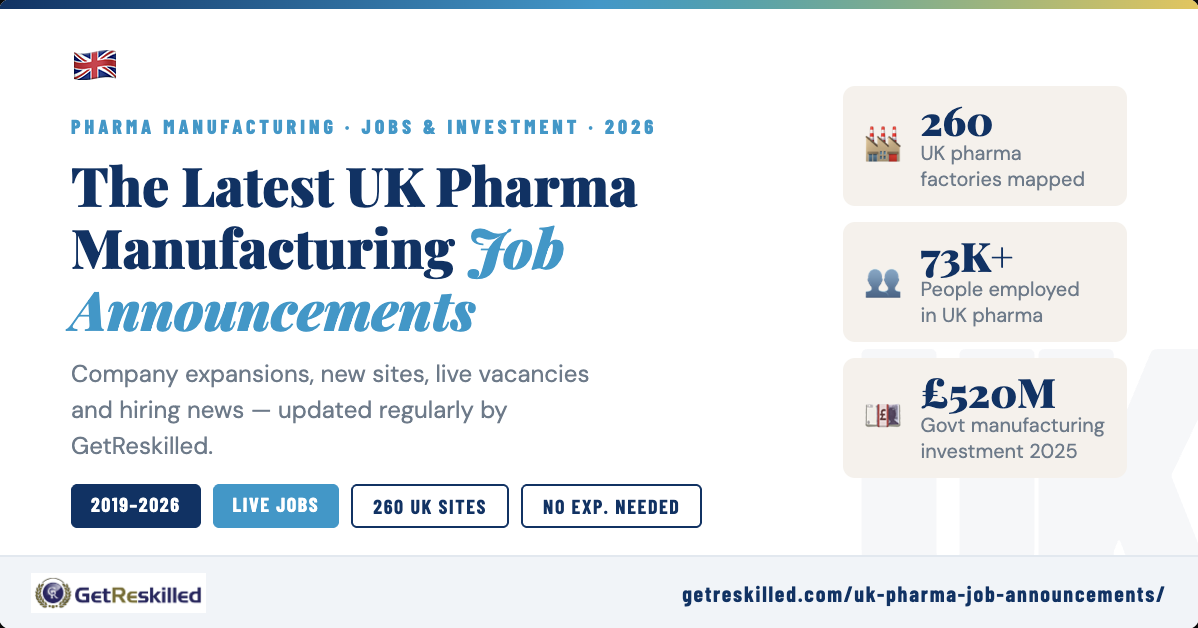
The UK pharmaceutical and medical device manufacturing industry employs over 73,000 people, contributes £28.5 billion to the UK economy annually, and — despite well-publicised investment challenges — continues to create significant employment opportunities for people from all backgrounds across England, Scotland, Wales and Northern Ireland.
This page is GetReskilled’s regularly updated record of every significant UK pharma manufacturing job announcement, site expansion and investment commitment — from 2019 through to 2026. But it is more than just a news tracker. You will also find a live UK pharma jobs board, an interactive map of 260 UK manufacturing sites, a guide to the qualifications you need, current salary benchmarks, and honest answers to the questions most pharma job resources won’t address — including whether UK pharma is actually a safe career choice right now.
Whether you are researching which companies are expanding near you, considering a career change into the industry, or already working in UK pharma and looking for your next move — everything you need is on this page.
Table of Contents for this article
-
-
-
-
-
- UK Resource Hub — All UK Pharma Job Resources on GetReskilled
- TL;DR — UK Pharma Manufacturing Job Announcement Summary
- UK Pharma Manufacturing by Region
- What Qualifications Do You Need for UK Pharma Manufacturing Jobs?
- How to Find UK Pharma Manufacturing Jobs Near You
- Live UK Pharma Manufacturing Jobs
- UK Pharma Manufacturing Companies to Watch in 2026
- Leading Pharmaceutical Companies in the UK
- 2026 Announcements
- 2025 Announcements
- 2024 Announcements
- 2023 Announcements
- 2022 Announcements
- 2021 Announcements
- 2020 Announcements
- 2019 Announcements
- What Do These Jobs Actually Pay?
- Is UK Pharma Manufacturing a Safe Career Choice in 2026?
- How to Apply to a Specific UK Pharma Company
- What Is It Actually Like to Work in UK Pharma Manufacturing?
- Other Key Frequently Asked Questions (FAQ) About UK Pharma Manufacturing Jobs
- Ready to Apply? These Resources Will Help
- Want to Work in UK Pharmaceutical Manufacturing?
- References & Sources
-
-
-
-
UK Resource Hub — All UK Pharma Job Resources on GetReskilled
- UK Pharma Jobs Board — live vacancies updated daily across the UK
- Interactive Map — 260 UK Pharma Factories — find manufacturing sites near you
- 195 UK Pharma & Med Device Companies — direct links to every career page
- UK Job Hunting Resource Centre — 40 tools, templates and guides
- Top 10 Pharma & Med Device Companies in the UK — ranked by size and significance
- UK Pharma Factory Map — 260 manufacturing locations plotted on Google Maps
TL;DR — UK Pharma Manufacturing Job Announcement Summary
- UK pharma employs approximately 73,000 people in manufacturing and is one of the UK’s most significant industrial sectors
- The July 2025 Life Sciences Sector Plan commits £520 million in manufacturing investment grants to make the UK Europe’s leading life sciences economy by 2030
- AstraZeneca resumed a paused £300 million investment in April 2026 — committing to sites in Cambridge and Macclesfield
- FUJIFILM Diosynth Biotechnologies invested £400 million in Billingham, Teesside — creating the largest multi-modal biopharmaceutical manufacturing site in the UK
- GSK has major UK manufacturing sites at Barnard Castle (Durham), Worthing (West Sussex), Irvine (Ayrshire) and Ware (Hertfordshire) — employing thousands of people across these sites
- The UK hosted 9.5% of the world’s advanced therapy clinical trials in 2024 — a major competitive strength
- Want to work in UK pharma manufacturing? See our UK job hunting resource centre and BSc (Hons) in Pharmaceutical Manufacturing
UK Pharma Manufacturing by Region
The UK’s pharmaceutical manufacturing industry is spread across the country. GetReskilled has dedicated guides to some of the most significant regional clusters:
- England’s North West — home to AstraZeneca (Macclesfield), Lonza (Slough is nearby), and a growing cluster of CDMOs. Generates 38% of all UK pharmaceutical output.
- Wales — a thriving life science sector employing over 13,000 people across 300+ companies including Ipsen (Wrexham), PCI Pharma Services (Tredegar) and Norgine.
- Scotland — over 5,600 people directly employed in pharma manufacturing including FUJIFILM Diosynth (Billingham is just across the border), Piramal (Grangemouth), and Valneva (Livingston).
| Region | Key Employers | Notable Facts | GetReskilled Guide |
|---|---|---|---|
| North West England | AstraZeneca, Lonza, Catalent | Generates 38% of all UK pharma output | North West guide → |
| Wales | Ipsen, PCI Pharma, Norgine | 13,000+ employed · 300+ companies | Wales guide → |
| Scotland | FUJIFILM Diosynth, Piramal, Valneva | 5,600+ employed · £575M+ exports | Scotland guide → |
| North East England | FUJIFILM Diosynth, MSD, GSK | Teesside is the UK’s largest CDMO cluster | — |
| South East England | Pfizer, GSK, AstraZeneca | Cambridge “Golden Triangle” hub | — |
| Northern Ireland | Almac, Randox, Norbrook | Almac alone employs 2,650+ at Craigavon | — |
What Qualifications Do You Need for UK Pharma Manufacturing Jobs?
This is one of the most common questions people ask when considering a career in UK pharmaceutical manufacturing — and the answer is more accessible than most people expect.
For entry-level operator and technician roles — the most common starting point for career changers — most UK pharma employers do not require a science degree. What they consistently look for is:
- An understanding of Good Manufacturing Practice (GMP) — the regulatory framework that governs how medicines are made
- A safety-first mindset and the ability to follow standard operating procedures carefully
- Attention to detail and accurate record-keeping
- A willingness to learn and be coached
The University of South Wales and GetReskilled’s BSc in Pharmaceutical and Medicinal Product Manufacturing is specifically designed to give people from any background — including those with no previous science or manufacturing experience — exactly this foundation before they apply. It is the most direct route into an entry-level UK pharma manufacturing role for career changers.
For more senior roles — including validation, quality assurance, engineering and CSV — specific technical qualifications are typically required. See our full guide to types of careers in the pharmaceutical industry and the salaries and job descriptions for each function.
How to Find UK Pharma Manufacturing Jobs Near You
The best way to find pharmaceutical manufacturing jobs near you in the UK is to combine three approaches:
- Use our interactive map of 260 UK pharma factories — find every manufacturing site within commuting distance of where you live
- Check our UK pharma jobs board — live vacancies updated regularly across the UK
- Apply speculatively to companies in your area — using our 195 UK pharma company directory with direct links to every career page. Many pharma roles are filled before they are advertised publicly.
For a full step-by-step guide to finding your first UK pharma role, see our UK job hunting resource centre — 40 tools, templates and guides built specifically for pharma job seekers.
Live UK Pharma Manufacturing Jobs
The following vacancies are updated in real time from our UK pharma jobs board. Use the search and filter tools to find roles near you.
Can’t find what you’re looking for? View all vacancies on our full UK pharma jobs board or use our interactive map of 260 UK pharma factories to find manufacturing sites near you.
UK Pharma Manufacturing Companies to Watch in 2026
Based on current investment activity and employee numbers, these are the UK pharmaceutical manufacturers most likely to generate significant hiring announcements in the near term. If you are looking for a role in UK pharma manufacturing, these companies are worth following directly.
- Lonza (Slough, Berkshire) — approximately 1,300 employees at their 210,000 sq ft biopharmaceuticals manufacturing and development facility. One of the world’s leading CDMOs, the Slough site is Lonza’s centre of excellence for mammalian biopharmaceutical manufacturing and has been actively expanding capacity with new single-use bioreactor systems.
- Ipsen (Wrexham, Wales) — approximately 850 employees across UK sites, with around 470 at Wrexham. Ipsen has invested £102 million since 2022 including a new £27 million flexible drug product manufacturing facility. The Wrexham site is Ipsen’s global neuroscience centre of excellence, manufacturing products exported to over 90 countries.
- MSD (Cramlington, Northumberland) — approximately 400 employees at their Cramlington manufacturing site. MSD (known as Merck in the US) is one of the world’s largest pharmaceutical companies and their Cramlington facility is one of the principal UK manufacturing operations for the group.
- Sanofi (Haverhill, Suffolk) — approximately 300 employees doing Active Pharmaceutical Ingredient (API) manufacturing. Sanofi is one of the world’s largest pharmaceutical companies and their Haverhill site is a significant UK manufacturing operation.
- PCI Pharma Services (Tredegar, Wales) — approximately 440 employees. One of the UK’s most active contract pharmaceutical manufacturers with a track record of expansion — the Tredegar site has previously received investment to create over 100 new jobs. For a full list of UK pharmaceutical and medical device companies, see our directory of 195 UK pharma and med device companies.
| Company | Location | Employees | Speciality | Recent Activity |
|---|---|---|---|---|
| Lonza | Slough, Berkshire | ~1,300 | Mammalian biopharmaceuticals (CDMO) | Ongoing capacity expansion |
| Ipsen | Wrexham, Wales | ~850 UK total | Neurotoxin / biologics manufacturing | £102M invested since 2022 |
| MSD | Cramlington, Northumberland | ~400 | Pharmaceutical manufacturing | Active manufacturing site |
| Sanofi | Haverhill, Suffolk | ~300 | API manufacturing | Established site |
| PCI Pharma Services | Tredegar, Wales | ~440 | Contract pharma manufacturing | History of expansion — 100 jobs in 2020 |
Leading Pharmaceutical Companies in the UK
The UK is home to some of the world’s most significant pharmaceutical and medical device manufacturers. The companies listed in our Top 10 Pharmaceutical and Medical Device Companies in the UK guide represent the largest employers by workforce — covering GSK, AstraZeneca, Pfizer, Johnson & Johnson, and more.
Beyond the largest names, the UK has a thriving ecosystem of contract development and manufacturing organisations (CDMOs) — including FUJIFILM Diosynth Biotechnologies (Billingham), Catalent (Swindon), Piramal Pharma Solutions (Grangemouth and Morpeth) and Lonza (Slough) — which collectively employ thousands of people and are often more accessible entry points for career changers than branded pharma companies.
For a complete directory of UK pharmaceutical and medical device companies with links to their careers pages, see our directory of 195 UK pharma and med device companies.
Summary of the Key Job Announcements, Investments and Plant Expansions in the UK – 2019 to 2026
| Year | Company | Location | Investment / Jobs |
|---|---|---|---|
| 2026 | AstraZeneca | Cambridge & Macclesfield | £300 million resumed |
| 2025 | UK Government | Nationwide | £520M Life Sciences Manufacturing Fund |
| 2023 | FUJIFILM Diosynth | Billingham, Teesside | £400M · 350 new jobs |
| 2023 | Piramal Pharma Solutions | Grangemouth & Morpeth | £55M · new jobs at both sites |
| 2022 | Bristol Myers Squibb | UK | £17M headquarters expansion |
| 2021 | GSK | Stevenage, Hertfordshire | Up to 5,000 new jobs |
| 2021 | Thornton & Ross | Huddersfield, Yorkshire | 100 new jobs |
| 2020 | Thermo Fisher Scientific | Swindon, Wiltshire | 200 new jobs |
| 2020 | Randox | Antrim, Northern Ireland | 200 new staff |
| 2020 | PCI Pharma Services | Tredegar, Wales | 50–100 new jobs |
| 2019 | Lonza | Slough, Berkshire | 180 new jobs |
| 2019 | Catalent | Swindon, Wiltshire | £20M · 100 new jobs |
| 2019 | Pfizer | Sandwich, Kent | £5M investment |
2026
- AstraZeneca (Cambridge & Macclesfield) — announced a £300 million resumption of previously paused UK investments in April 2026. A new facility in Cambridge will house approximately 1,000 data scientists and molecular researchers. The Macclesfield site — which already employs around 4,000 people — will receive investment to build what CEO Pascal Soriot described as “a lab of the future” using digital and data tools to advance drug development. The announcement followed a pharmaceutical arrangement with the United States and reversed a pause introduced in September 2025 amid NHS drug pricing negotiations.
2025
- UK Government — the July 2025 Life Sciences Sector Plan committed £520 million in manufacturing investment grants via the Life Sciences Innovative Manufacturing Fund, with the goal of making the UK Europe’s leading life sciences economy by 2030. The plan also includes a new national Health Data Research Service and a pre-clinical translational models hub. The number of dedicated UK cell and gene therapy manufacturers rose from 22 in 2022 to 26 in 2023, with the UK hosting 9.5% of the world’s advanced therapy clinical trials in 2024.
2024
- AstraZeneca (Cambridge) — announced plans for a major new Cambridge facility, first revealed in 2024, designed to accommodate around 1,000 employees including data scientists and molecular researchers. The project was paused in September 2025 before being confirmed again in April 2026.
- Almac (Northern Ireland) — received government support as part of a combined £84 million investment by two pharmaceutical companies expanding their UK manufacturing plants, backed by £7.5 million from the UK government’s manufacturing transformation fund. Almac operates its global headquarters and principal manufacturing operations at Seagoe Industrial Estate, Craigavon, County Armagh.
- UK cell and gene therapy sector — the number of dedicated UK manufacturers in this emerging field rose from 22 in 2022 to 26 in 2023, with continued growth into 2024, cementing the UK’s position as a global leader in advanced therapies and gene medicines.
2023
- FUJIFILM Diosynth Biotechnologies (Billingham, Teesside) — completed the first phase of its £400 million expansion, with new microbial manufacturing facilities and gene therapy suites becoming operational. The expansion created the largest multi-modal biopharmaceutical manufacturing site in the UK and added up to 350 highly skilled jobs to the Teesside campus, which already employed over 1,000 people. The site at Belasis Avenue, Billingham is now one of the most significant CDMO facilities in Europe.
- Piramal Pharma Solutions (Grangemouth, Scotland & Morpeth, England) — completed construction of a new Antibody-Drug Conjugate (ADC) manufacturing and aseptic fill/finish facility at Grangemouth (Stirlingshire) and enhanced Active Pharmaceutical Ingredient (API) manufacturing at Morpeth (Northumberland), as part of a £55 million combined investment announced in February 2022.
2022
- FUJIFILM Diosynth Biotechnologies (Billingham, Teesside) — broke ground in September 2022 on its large-scale microbial manufacturing facility expansion as part of the wider £400 million Billingham campus investment. The expansion added over 20,000 sq ft of modular clean room space and was designed to increase microbial fermentation capacity by 70% once operational.
- Piramal Pharma Solutions (Grangemouth, Scotland) — commenced construction on its new ADC manufacturing facility at Grangemouth as part of the combined £55 million UK expansion programme announced in February 2022.
- Catalent (Swindon, Wiltshire) — the contract drug manufacturer employs over 650 people at their Swindon site, one of the largest pharmaceutical contract manufacturing operations in the UK. Catalent operates multiple UK sites including Nottingham, Dartford and Bathgate (West Lothian), making them one of the country’s most significant CDMOs for companies seeking UK manufacturing partners.
- Thermo Fisher Scientific (Swindon, Wiltshire) — following significant UK expansion activity and the acquisition of multiple manufacturing assets, Thermo Fisher has strengthened its UK manufacturing presence. Their Swindon site is one of the company’s principal UK manufacturing operations.
2021
- GSK (Hertfordshire) – announced plans to expand their Stevenage site to form a new UK hub that will create up to 5,000 new jobs over the next 5-10 years
- Thornton & Ross (West Yorkshire) – created 100 new jobs in Huddersfield with support from Leeds City Region Enterprise Partnership
- Piramal Pharma (Stirlingshire) – applied for permission to extend their Grangemouth site, that would lead to the creation of 70 new roles
2020
Despite a difficult year for many industries, the UK’s pharma and med device manufacturing industries continued to thrive. Here’s a run down of the announcements from throughout the year:
- PCI Pharma Services (Gwent) – gained approval for a site expansion that includes a new packaging building, which will bring 50-100 new jobs to the area
- Randox (Antrim) – announced the recruitment of 200 new staff in May, to help support the COVID-19 testing capabilities.
- Thermo Fisher Scientific (Wiltshire) – are expanding their Swindon site with the creation of 200 new jobs
- Valneva (West Lothian) – announced the creation of 75 new jobs as the site expanded to support COVID-19 vaccine manufacture
The UK Government also announced the new Medicines and Diagnostic Manufacturing Transformation Fund – a £20m fund designed to support the improvement of medicine supply chains within the UK and “create thousands of jobs“.
2019
- Almac (Lothian) – are doubling their Edinburgh facility footprint to scale up personalised cancer vaccine activities
- Catalent (Wiltshire) – announced the creation of 100 new jobs as a result of £20m investment to boost production capabilities
- Lonza (Berkshire) – are expanding their Slough site which is expected to lead to 180 new jobs
- Pfizer (Kent) – invested £5m in the Discovery Park in Sandwich to grow its development and manufacture of paediatric medicines at the site
What Do These Jobs Actually Pay?
Entry-level pharmaceutical manufacturing operator and technician roles in the UK typically start at £25,000–£32,000, with shift allowances and benefits on top. More senior and specialist roles pay significantly more. GetReskilled’s salary guide covers manufacturing, engineering, quality, validation and science roles — with job descriptions for each.
| Role | Typical UK Salary Range | Experience Level |
|---|---|---|
| Manufacturing Operator | £25,000 – £32,000 | Entry level |
| Production Technician | £28,000 – £38,000 | Junior / mid |
| Quality Assurance Specialist | £32,000 – £48,000 | Mid level |
| Validation / CQV Engineer | £35,000 – £55,000 | Mid / senior |
| CSV Engineer | £40,000 – £65,000 | Mid / senior |
| Production / Manufacturing Manager | £50,000 – £80,000+ | Senior |
Salary ranges are indicative for UK pharmaceutical and medical device manufacturing roles as of 2026. Shift allowances, bonuses and benefits are typically additional. See our full UK pharma salary guide for detailed breakdowns by function.
Is UK Pharmaceutical Manufacturing a Safe Career Choice in 2026?
This is the question anyone researching UK pharma jobs should ask — and it deserves an honest answer.
Several factors make UK pharma manufacturing structurally resilient as a career — even when the investment headlines look difficult:
- Manufacturing is stickier than R&D. While R&D investment is more volatile, existing manufacturing sites — GSK’s Barnard Castle, FUJIFILM’s Billingham, Lonza’s Slough — continue operating and hiring regardless of investment climate because medicines still need to be made every single day.
- The government is actively intervening. The July 2025 Life Sciences Sector Plan committed £520 million specifically to manufacturing. The April 2026 US-UK pharmaceutical arrangement reversed AstraZeneca’s investment pause within months — demonstrating that government commitment to this sector as a strategic priority is stronger than it has been in years.
- Cell and gene therapy roles are growing fast. The ABPI projects cell and gene therapy manufacturing roles will increase 117% by 2026 over 2021 levels, with bioprocessing roles rising 151%. These are overwhelmingly UK manufacturing jobs.
- CDMOs are insulated from brand-level volatility. Contract manufacturers like FUJIFILM Diosynth, Catalent, Piramal and Lonza serve multiple clients across multiple countries. When one pharma company reduces UK activity, CDMOs pivot to other clients — making their workforce considerably more stable than branded pharma sites.
- The UK pharmaceutical industry added £28.5 billion to the economy in 2025 and exported almost £21 billion in pharmaceutical products worldwide — it remains one of the most economically significant sectors in the country.
- There is a structural skills shortage. The ABPI estimates that delivering a supportive manufacturing environment could create an additional 26,500 jobs over the next 10 years — but only if the skills pipeline keeps pace. People who retrain now are entering the market ahead of that demand curve.
Our view: UK pharmaceutical manufacturing is a structurally sound career choice — particularly for entry-level operator and technician roles, validation professionals and CSV engineers. The volatility is concentrated in R&D investment decisions made at global headquarters level. It rarely affects the day-to-day hiring needs of manufacturing sites. If you are considering retraining, the manufacturing floor is considerably more stable than the investment headlines suggest.
How to Apply to a Specific UK Pharma Company
Every major UK pharmaceutical manufacturer runs their own recruitment process. The most reliable route to any company’s current vacancies is always their own careers page — not third-party job boards, which often lag behind or post expired roles. Our directory of 195 UK pharma and med device companies links directly to the careers page of every major UK employer.
Three things that consistently make applications stand out for UK pharma manufacturing roles:
- Demonstrate GMP awareness — even in your cover letter. Use the phrase “Good Manufacturing Practice” and show you understand why it matters. Most applicants from outside the industry don’t do this, and it immediately signals you are serious about the sector. Our GMP guide will give you everything you need to write confidently about it.
- Apply speculatively as well as to live vacancies. Many pharma manufacturing roles — particularly operator and technician positions — are filled before they are publicly advertised. A well-targeted speculative application to the HR team at a site near you is often more effective than competing for advertised roles. Use our interactive map of 260 UK pharma factories to find sites within commuting distance.
- Get a qualification before you apply if you are a career changer. Our analysis of 100 entry-level UK pharma job ads showed that GMP knowledge and relevant training are among the most consistently requested attributes — even for roles that don’t formally require a degree. A relevant qualification removes the single biggest barrier to getting shortlisted.
For more detailed guidance, see our complete UK pharma job hunting resource centre — 40 tools, templates and guides built specifically for people trying to break into the UK pharma industry.
What Is It Actually Like to Work in UK Pharma Manufacturing?
Understanding what a pharma manufacturing job involves day-to-day is one of the most important things to know before retraining — and it’s a question that job boards and company websites rarely answer honestly.
Pharmaceutical manufacturing sites are highly regulated, clean, process-driven environments. The work involves following Standard Operating Procedures (SOPs) carefully and precisely, maintaining detailed batch records and documentation, and working as part of a closely-knit team where safety and quality are the absolute priority above everything else.
It is not physically demanding in the way traditional factory work is. It is mentally disciplined, detail-oriented work in a controlled environment — closer in character to working in a hospital or laboratory than on a traditional factory floor. Most sites operate on shift patterns which suit people with family commitments, and entry-level salaries — typically £25,000–£32,000 plus shift allowances — are significantly above the UK average for roles that don’t require a degree.
GetReskilled graduates who have made the transition from completely different industries describe it this way:
“Take it on with a view to not just completing it and getting a result… There’s a course worth learning, not just passing.” — Pat O’Loughlin, Lead Maintenance Technician (Semiconductor Manufacturing) → Process Technician (Pharma)
“It seems to be a booming industry… it’s absolutely worthwhile investing a little bit of your own downtime.” — Jason Cummins, Food Industry → Production Technician (Medical Device Manufacturing)
“I think it’s a good career to be in. The industry’s definitely buoyant at the moment.” — Regina McNamara, Professional Painter → Product Builder (Medical Device Manufacturing)
For a closer look at what UK pharma plants actually look like from the inside — including video tours from employers — see our guide: Take a look inside the UK’s pharma plants →
For the full collection of GetReskilled graduate stories — including people who changed careers from dentistry, optometry, engineering consultancy and food manufacturing — see our 87 reviews and graduate success stories →
Frequently Asked Questions About UK Pharma Manufacturing Jobs
Is UK pharmaceutical manufacturing growing or declining?
The picture is mixed. Overall UK pharmaceutical manufacturing output has declined since its 2017 peak, and the UK has fallen in global rankings for pharma investment. However, the government’s July 2025 Life Sciences Sector Plan — which commits £520 million in manufacturing investment grants — signals a clear intent to reverse this trend and make the UK Europe’s leading life sciences economy by 2030. High-value areas such as cell and gene therapy, biologics and advanced therapeutics continue to see significant investment and job creation.
Which companies are currently investing in UK pharma manufacturing?
AstraZeneca resumed a paused £300 million investment in Cambridge and Macclesfield in April 2026. FUJIFILM Diosynth Biotechnologies completed a £400 million expansion at Billingham, Teesside creating the largest multi-modal biopharmaceutical site in the UK. GSK continues to develop its Stevenage hub with plans for up to 5,000 jobs over the next decade. Piramal Pharma Solutions has invested in both Grangemouth (Scotland) and Morpeth (England).
Where are the main pharmaceutical manufacturing hubs in the UK?
The UK’s main pharma manufacturing hubs are concentrated in the South East (Kent, Hertfordshire, Cambridgeshire), the North East (Teesside, County Durham), Scotland (Grangemouth, Edinburgh), Wales, and Northern Ireland. GSK’s sites in Barnard Castle (County Durham), Worthing (West Sussex) and Stevenage (Hertfordshire) are among the largest. AstraZeneca’s Macclesfield site in Cheshire employs approximately 4,000 people. See our interactive map of 260 UK pharma factories for a full geographic breakdown.
Do I need a science degree to get a job in UK pharma manufacturing?
No — many entry-level manufacturing operator and technician roles in UK pharmaceutical companies are open to people from non-science backgrounds. What employers consistently look for is an understanding of GMP (Good Manufacturing Practice), a safety mindset, and a willingness to follow procedures carefully. GetReskilled’s online courses are specifically designed to give people from any background the knowledge they need to apply confidently for entry-level pharma manufacturing roles in the UK.
How do I keep up with new UK pharma job announcements?
The best sources are individual company newsrooms, the ABPI (Association of the British Pharmaceutical Industry) website, and trade publications such as Manufacturing Chemist, the Pharmaceutical Journal, and PharmiWeb. GetReskilled also maintains this regularly updated page and a UK pharma jobs board with live vacancies. You can also sign up for our monthly email newsletter which covers UK pharma industry news alongside job hunting tips.
What are the leading pharmaceutical companies in the UK?
The UK’s largest pharmaceutical employers include GSK (major manufacturing sites at Barnard Castle, Worthing, Irvine and Ware), AstraZeneca (Macclesfield and Cambridge), Pfizer (Sandwich, Kent and Havant), and Johnson & Johnson. The UK also has a significant contract manufacturing sector led by Lonza (Slough), Catalent (Swindon and Nottingham), FUJIFILM Diosynth Biotechnologies (Billingham, Teesside) and Piramal Pharma Solutions (Grangemouth and Morpeth). See our full Top 10 UK Pharma Companies guide and 195 company directory for the complete picture.
What qualifications do I need to get a job in pharmaceutical manufacturing in the UK?
For entry-level manufacturing operator and technician roles — the most common starting point for career changers — a science degree is not required. UK pharma employers prioritise an understanding of GMP (Good Manufacturing Practice), a safety mindset, and the ability to follow procedures carefully. GetReskilled’s Conversion Course into Pharmaceutical Manufacturing is designed specifically to give people from any background this foundation. For more senior roles in validation, quality, engineering and CSV, specific technical qualifications apply — see our pharma careers guide for a full breakdown.
Ready to Apply? These Resources Will Help
- How to get into pharma with no experience — the most common starting point
- How to write a pharma CV — ultimate guide — written by Claire Wilson BSc
- 26 myths about finding a job in pharma — addresses every common objection
- How long does it take to get a job in pharma? — sets realistic expectations
- What we learned from 100 entry-level job ads — original research on what employers want
- 7 deadly sins of pharma job applications — what to avoid
Want to Work in UK Pharmaceutical Manufacturing?
GetReskilled offers fully online, part-time courses designed specifically to get you into the pharmaceutical and medical device manufacturing industry in the UK — including a BSc (Hons) Degree in Pharmaceutical and Medicinal Product Manufacturing and specialist validation and CSV courses. No previous industry experience required for entry-level programmes.
🇬🇧 GetReskilled in the UK
GetReskilled has been helping people retrain for careers in pharmaceutical and medical device manufacturing since 2005. We have a dedicated UK office in Cardiff, Wales — the heart of one of the UK’s most active pharma manufacturing regions — and our courses are specifically designed for people looking to enter or progress within the UK pharma industry.
UK Office
Falcon Drive
Cardiff, CF10 4RU
Wales, United Kingdom
+44 (0) 780 237 0554
UK Awards
🏆 Best Online Learning Experience
Irish Education Awards
🥈 VET Excellence Awards
European Commission
Partner University Spotlight
University of South Wales — Cardiff
GetReskilled has partnered with the University of South Wales (USW) — a brick-and-mortar university based in Cardiff, Wales — to deliver the BSc (Hons) Degree in Pharmaceutical and Medicinal Product Manufacturing. This partnership means students get the flexibility of online distance learning combined with the credibility of a degree from an established UK university.
Qualification
BSc (Hons) Degree
Pharmaceutical & Medicinal Product Manufacturing
Programme
14 modules · 4 years
Online · Part-time · No UCAS required
Entry Requirements
No A-levels needed
No access course · No personal statement
Milestones
Certificate after Year 1
Higher Certificate after Year 2 · BSc after Year 4
“You get all the benefits of distance learning with the confidence of a degree from a brick-and-mortar university — and the programme is specifically designed for mature students who have jobs, families and ongoing responsibilities.”

Gerry Creaner
President
Senior Lecturer with GetReskilled
Gerry Creaner has over 40-years of experience in the Life Sciences Manufacturing industry across a range of technical, managerial and business roles. He established a very successful engineering consultancy prior to founding GetReskilled, an online education and learning business, with offices in Singapore, Ireland and Boston (USA), focussed on the manufacture of safe and effective medicines for the public.
He is also a founding Director of two Singapore based philanthropic organizations, the Farmleigh Fellowship and the Singapore-Ireland Fund, both of which deepen the well established and historical Singapore – Ireland relationship and deliver long-term benefits to both countries.
Gerry has an undergraduate degree in Chemical Engineering (UCD, 1980) and an MSc (Management) from Trinity College Dublin (2003) and is currently doing research for his Ph.D.
References & Sources
All investment figures, employee numbers and job announcement data cited on this page are sourced from official company announcements, government publications and verified trade press. Last reviewed May 2026.
2026
- AstraZeneca — AstraZeneca to pump £300m into UK — Insider Media, April 2026
- AstraZeneca — AstraZeneca commits £300m to revive Cambridge growth plans — Business Weekly, April 2026
- AstraZeneca — AstraZeneca resumes £300m UK investment — Manufacturing Chemist, April 2026
2025
- UK Government — Life Sciences Sector Plan — UK Government, July 2025
- NHS Confederation — Life Sciences Sector Plan: what you need to know — NHS Confederation, July 2025
- ABPI — UK tumbles down global rankings for pharma investment — ABPI, September 2025
2024
- UK Government — £360 million to boost British manufacturing and R&D — UK Government, March 2024
- VWV — Manufacturing investment announcements paint exciting future for UK life sciences — VWV, April 2026
2023
- FUJIFILM Diosynth Biotechnologies — FUJIFILM Diosynth confirms £400 million investment — FUJIFILM Diosynth, December 2021 (site operational 2023)
- BioProcess International — FUJIFILM Diosynth to create major biopharma site in UK — BioPharm International
- Piramal Pharma Solutions — Piramal Pharma Solutions strengthens UK presence — PR Newswire, February 2022 (completed 2023)
2022
- FUJIFILM Diosynth Biotechnologies — FUJIFILM Diosynth breaks ground at Billingham microbial plant — FUJIFILM, September 2022
- Piramal Pharma Solutions — Piramal £55 million UK expansion — PR Newswire, February 2022
- British Stainless Steel Association — Investment by big pharma creates new construction opportunities — BSSA, 2022
2021
- BBC News — GSK plans to create up to 5,000 jobs at Stevenage hub — BBC News, 2021
- Yorkshire Post — Thornton & Ross creates 100 jobs in Huddersfield — Yorkshire Post, 2021
- Falkirk Herald — Expansion plan for Grangemouth cutting-edge factory — Falkirk Herald, 2021
2020
- Business Live — PCI Pharma Services creating up to 100 jobs in Gwent — Business Live, 2020
- Swindon Advertiser — Thermo Fisher Scientific expansion to create 200 new Swindon jobs — Swindon Advertiser, 2020
- Insider.co.uk — Valneva Livingston factory to expand — Insider, 2020
- UK Government — Prime Minister announces £20m to grow medicines manufacturing — UK Government, 2020
2019
- Outsourcing Pharma — Almac expanding personalised cancer vaccine production facilities — Outsourcing Pharma, 2019
- Swindon Advertiser — Catalent investing £20m, creating 100 new Swindon jobs — Swindon Advertiser, 2019
- BioProcess International — Lonza adding single-use capacity and 180 jobs at UK mammalian plant — BioProcess International, 2019
- Kent Online — Pfizer invests £5m in Discovery Park Sandwich — Kent Online, 2019
Industry Data & Statistics
- ICAEW — Pharmaceuticals in the UK: industry profile — ICAEW, 2026
- Lonza — Lonza Slough — 1,300 employees, mammalian biopharmaceuticals — Lonza.com
- Ipsen — Ipsen in the UK — 850 employees, £102 million invested since 2022 — Ipsen.com
- PharmiWeb — Ipsen Wrexham recognised as one of UK’s Best Workplaces — PharmiWeb, 2023
Post Your Comments Below